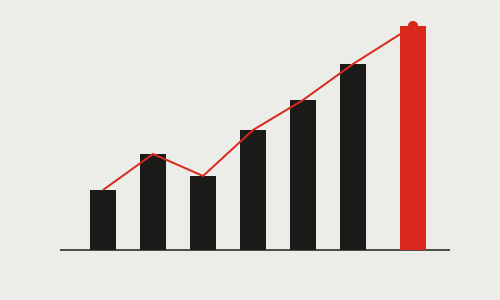
- · Nearly half of Swiss family businesses have no formal succession plan, leaving capital division arrangements dangerously unresolved.
- · The 2023 Swiss inheritance law revision expanded testamentary freedom, giving founders more room to route the operating business to a successor while compensating other heirs through non-business assets or structured payments.
- · Swiss law mandates financial compensation for non-active heirs; without advance planning, courts can impose valuations or order forced sales that destroy enterprise value.
- · Capital division planning takes time: the average Swiss SME succession process runs 6.6 years, and the mechanisms that prevent deadlock must be engaged well before a transition is imminent.
There is a particular kind of problem that Swiss family businesses carry without fully acknowledging it. It does not appear on any balance sheet, it generates no regulatory filing requirement, and it is easy to postpone indefinitely while the founder is healthy and the company is performing. The problem is the question of what happens to ownership when one child runs the business and two others do not.
Swiss inheritance law has a clear answer to that question. The answer is: the active heir compensates the rest. What the law does not provide is the financing, the agreed valuation, or the timeline. Those must be arranged in advance — and according to a 2025 Swiss Family Business Survey, 47% of Swiss family businesses have not yet formalized their succession process at all. For nearly half the market, the answer to "how will capital be divided among heirs?" remains, effectively, undecided.
The consequences of that gap tend to arrive at the worst possible moment.
Swiss inheritance law establishes protected shares, known as Pflichtteile, for descendants. These are not optional considerations to weigh alongside family dynamics and founder preference. They are legally enforceable entitlements. When an estate includes a privately held operating company, and one heir receives the business while siblings receive nothing or less, those siblings retain the right to compensation reflecting their protected portion — regardless of whether the founder's intent was different.
Prior to 2023, the Pflichtteil for children stood at three-quarters of their statutory entitlement. The revised Swiss inheritance law, effective January 1, 2023, reduced that protected share to one-half of the statutory entitlement, and abolished the parental protected portion entirely. The practical effect is meaningful: founders now have greater freedom to allocate the operating business to a successor while directing other estate assets — real estate, securities portfolios, cash — toward compensating non-active heirs.
As noted by UBS in its analysis of the reform, the revision was explicitly designed to facilitate SME succession by reducing the likelihood of forced cash-outs that destabilize operating companies. Yet the reform does not eliminate the obligation to compensate; it expands the founder's room to structure how that compensation is delivered. The distinction matters. Expanded testamentary flexibility is only useful when exercised.
The Swiss SME Portal (kmu.admin.ch), operated by SECO, identifies four primary instruments through which capital division between active and non-active heirs can be structured in an orderly way.
The first is direct equalization payments from the active heir to the non-active heirs. This is the most straightforward mechanism, but it demands that the active heir have access to sufficient liquidity — either through personal resources or through financing arrangements secured against the business itself. That liquidity must be planned, not assumed.
The second is court-appointed expert valuation. When heirs cannot agree on what the business is worth — a common friction point when one party has informational advantages over others — Swiss courts may appoint an independent expert to determine a binding value. This is a fallback mechanism, not a preferred path. Court-appointed processes are slower, less predictable in outcome, and more expensive than agreed valuations conducted during the founder's lifetime with professional guidance.
The third mechanism is phased share transfer during the founder's lifetime. Structured correctly under cantonal tax rules, gradual ownership transfers can reduce the liquidity burden on the active heir while also providing the founder with ongoing income or security arrangements. Timing and form are material: Swiss tax law is explicit that transferring shares below market value can trigger tax consequences, and the precise treatment varies by canton and by whether the transaction involves family or non-family counterparties.
The fourth is asset segregation: directing non-business assets to non-active heirs so that the operational company can transfer intact to the successor. This approach requires that the estate contain sufficient non-business assets of appropriate value, and it requires that those allocations be formally documented in advance — ideally through a properly structured will or an inheritance agreement (Erbvertrag) that binds all parties.
None of these mechanisms is complicated in principle. All of them require time, professional coordination, and a founder willing to engage with the subject before the succession moment arrives.
The UBS Succession Study 2026, produced by the Center for Family Business at the University of St. Gallen, estimates that 32% of Swiss SMEs will face a succession event within the next five years. That is a substantial portion of the market entering transition without, in many cases, the legal and financial architecture required to transfer ownership cleanly.
When capital division is left unresolved, the outcomes available to heirs tend to be worse than those available to founders who planned. If heirs cannot agree on allocation or valuation, Swiss courts may order a binding expert valuation. In unresolved cases, courts may mandate judicial allocation or a forced sale. A forced sale of a closely held operating company in a compressed timeframe, under conditions of family conflict, rarely produces a price that reflects the business's intrinsic value. It produces whatever the market will bear under those circumstances — and it typically ends both the family relationship and the enterprise in the same proceeding.
The average Swiss SME succession process, from initial planning to completion, runs 6.6 years. That figure alone argues for engaging capital division planning at least three to five years before any intended exit or transition date.
The experience of delayed planning is not unique to Switzerland. Across comparable legal systems, heirs regularly discover at the moment of inheritance that retaining an asset they want requires liquidity they do not have. A viral exchange on social media, originating in France but resonating across jurisdictions with forced heirship rules, captured the dynamic precisely:
Cette jeune femme dit tout haut ce que des millions de familles vont découvrir chez le notaire : la maison de leurs parents, ils ne pourront pas la garder. Pas parce qu'ils ne la veulent pas. Parce que l'État l'a décidé pour eux, sans jamais voter une seule hausse d'impôt.§ @ChienSurpris
One respondent in that exchange described the personal cost of unplanned succession directly:
C'est tout à fait vrai, je l'ai vécu récemment. Pour conserver la maison familiale de mes parents, j'ai fait un chèque de presque 80,000€ que j'ai du faire 6 mois après le décès, sous peine d'une majoration de 10%. J'avais anticipé en épargnant. Je n'ai plus rien en banque.§ @FrLeBourgeois
The arithmetic of succession liquidity is unambiguous:
En ligne directe, au-delà de 100 000 € par enfant, les droits de succession grimpent jusqu'à 45%. Un bien immobilier familial de 500 000 € transmis à un enfant unique génère plusieurs dizaines de milliers d'euros de droits à régler cash. L'héritier hérite d'un bien et d'une facture en même temps.§ @Nicolas_Finance
Switzerland's inheritance tax regime differs materially from France's — direct-line succession in most cantons is exempt from inheritance tax — but the structural problem is cognate. An heir who receives an illiquid asset and simultaneously owes compensation to co-heirs faces a liquidity event that must be funded from somewhere. If the planning has not been done, the options narrow quickly.
The valuation of a closely held SME is the technical fulcrum around which capital division disputes tend to rotate. Unlike listed securities, a privately held company has no observable market price at the moment of succession. Its value depends on methodology, assumptions, and the information available to the party conducting the assessment.
Active heirs and non-active heirs frequently have divergent interests in valuation. The active heir, who will continue to operate the company, has an interest in a lower valuation that reduces the equalization payment. Non-active heirs have the opposite interest. Without a pre-agreed valuation approach — established during the founder's lifetime with professional guidance and documented in a binding instrument — the gap between these positions often proves irreconcilable without court intervention.
SECO's guidance on company valuation (kmu.admin.ch) notes that the value of a company is determined by a range of quantitative and qualitative factors, and that the appropriate methodology varies by business type, industry, and purpose of valuation. For succession purposes, professional appraisal conducted in advance — and agreed upon by all parties while the founder can facilitate the conversation — is the most reliable way to anchor the capital division process.
For SME owners contemplating a succession that involves multiple heirs, the starting point is structural clarity. Who will operate the business? What assets exist outside the operating company that could satisfy non-active heirs' entitlements? What financing mechanisms are available to the active heir if equalization payments are required? Has a professional valuation been conducted? Has legal counsel reviewed the estate plan in light of the 2023 inheritance law revision?
These are not questions that require immediate answers, but they are questions that require early engagement. The 2023 reform gave Swiss business owners more room to maneuver than their predecessors had. Using that room requires deliberate structuring, professional valuation, and documentation prepared well in advance of the transition event.
Fiduciaries and M&A advisors who work with owner-managed businesses in Switzerland are increasingly being asked to address succession readiness alongside financial and operational due diligence. The market is moving in that direction because the cost of unresolved capital division — measured in legal fees, destroyed enterprise value, and fractured family relationships — has become too visible to ignore.
The mechanisms that prevent deadlock are well established under Swiss law. The question, as ever, is whether they are engaged in time.
SMEmarket is a transaction platform for Swiss SME acquisitions and successions. Nothing in this article constitutes legal, tax, or investment advice. Founders and advisors should consult qualified legal and financial professionals in connection with any succession or estate planning matter.