- · Switzerland has no public deal registry, forcing advisors to triangulate transaction multiples from specialist databases rather than official filings.
- · EBITDA multiples in active sectors range from 7x–12x for IT/SaaS to 3x–5x for retail, with Swiss precision manufacturing commanding a 1x–2x premium over German peers.
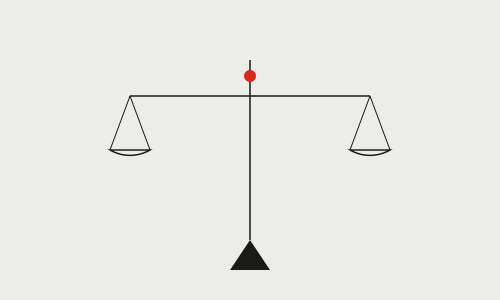
- · The gap between the statutory Praktikermethode and actual deal pricing is measurable and consistent, often exceeding CHF 2 million on a single mid-sized transaction.
- · Proper EBITDA normalization is the step most advisors underestimate, and where most negotiations break down.
Every Swiss M&A advisor eventually confronts the same structural problem: the market in which they are working leaves almost no public trace. A German advisor can consult the Bundesanzeiger. A British counterpart can retrieve filed accounts from Companies House. A Swiss advisor reaches for the same tools and finds, broadly speaking, nothing of practical use.
Swiss AG and GmbH accounts are filed with cantonal tax authorities. They are not published. This is not an administrative oversight — it reflects longstanding Swiss commercial culture around privacy — but its practical consequence is that no public transaction database exists for the domestic private market. Global platforms such as PitchBook, Inven, and Grata either model Swiss deal data from foreign comparables or omit it. Neither approach serves an advisor who needs to defend a valuation range in front of a sophisticated buyer or a founder who has spent three decades building a business.
The result is a market where information asymmetry is not the exception but the structural condition. Advisors who understand how to navigate it work from a materially stronger position. Those who rely on theoretical models alone risk presenting valuations that neither sellers can achieve nor buyers will pay.
The backdrop is not static. According to Deloitte's H1 2026 report on Swiss SME M&A activity, 208 transactions closed in 2025, representing a 16 percent increase over 2024. Private equity involvement in Swiss SME deals rose 45 percent year-over-year, and inbound acquisitions from foreign buyers increased 65 percent over the same period. IT services and software alone accounted for 90 percent of deal volume growth.
This is a market with capital chasing deals, not deals chasing capital. The SNB policy rate sits at 0 percent, making leverage cheap for PE acquirers. GDP growth is modest at 0.6 percent, which applies margin pressure across the economy and accelerates succession decisions for founder-owners who might otherwise have waited. These conditions compress the window during which a well-prepared seller can extract a premium.
Understanding what that premium looks like in practice requires working from actual transaction multiples, not sector averages derived from foreign markets.
Scalemetrics' H1 2026 analysis of Swiss SME deal data provides the most current publicly available picture of sector multiples:
trade at 7x to 12x EBITDA. Swiss B2B SaaS businesses with CHF 1 million to CHF 10 million in annual recurring revenue attract competition from local PE, German strategic buyers, and US sponsors. Recurring revenue and high gross margins justify the premium.
transact at 5x to 8x EBITDA. Swiss origin commands a 1x–2x premium over comparable German businesses, a reflection of quality reputation and export market positioning. This sector remains the consistent core of the Swiss acquisition market — the classic "hidden champion" that attracts both domestic and cross-border interest.
- · accounting, engineering, consulting — range from 4x to 7x EBITDA. The spread within this range is driven almost entirely by founder-centrality and customer concentration. A business where the founder controls all key relationships, holds institutional knowledge that is not documented, and appears personally on the client's preferred-contact list will trade at the lower end, regardless of its revenue quality on paper.
sit at 3x to 5x EBITDA, with structurally limited buyer appetite.
These are not theoretical constructs. They reflect what buyers are paying in closed transactions. The challenge is accessing the underlying deal data to make them actionable.
Three sources have established themselves as the practical infrastructure for Swiss private M&A transaction analysis, each with a distinct methodology.
ValIndex provides sector-specific EBITDA multiples across 132 Swiss industries, updated quarterly. Its analytical focus is the concept of stille Reserven — hidden reserves — which represent the gap between conservative statutory book value and true economic value. ValIndex's own worked example of a mid-sized Zurich precision manufacturer illustrates the point precisely: a statutory valuation under Praktikermethode of CHF 2.04 million versus a market deal valuation of CHF 4.46 million, a CHF 2.42 million spread. For a typical Swiss industrial SME, hidden reserves represent 30 to 60 percent of additional enterprise value above the statutory floor.
mynth operates as a free, crowdsourced database with contributions from Swiss M&A and private equity professionals. Transactions are cross-validated against public announcements and private documents, covering verified enterprise value, revenue multiples, EBITDA multiples, and transaction financials for European small to mid-cap deals. The crowdsourced model introduces a degree of variance, but cross-validation mitigates the most significant errors.
Dealert provides a searchable, structured transaction database designed specifically for precedent-transaction analysis. It covers closed and announced deals only, with disclosed versus estimated figures clearly separated. There are no rumor entries — a meaningful quality control in a market where informal deal gossip can masquerade as data.
Used together, these three sources provide a triangulation framework that no single platform can match independently.
The ValIndex analysis makes a point that deserves more attention than it typically receives in Swiss advisory practice: the Praktikermethode is not a valuation. It is a statutory minimum. Cantons apply multiples of roughly 3.5x to 5.5x depending on sector and jurisdiction, methodologies that were designed for tax assessment, not for determining what a motivated buyer from Frankfurt or San Francisco will pay for a market-leading Swiss precision manufacturer.
The arbitrage gap is the difference between these two figures — and it is not random. It is consistent, measurable, and largely explicable. It reflects buyer synergy potential that statutory methods do not capture, the value of recurring or contractual revenue streams, hidden reserves in property and equipment, and the premium that clean financial governance commands in a due diligence process.
An advisor who presents only the Praktikermethode to a seller is not being conservative. They are describing a different transaction than the one the market is willing to execute. Conversely, an advisor who presents only the market multiple without anchoring it to normalized EBITDA is building on an unstable foundation.
This is where most advisory engagements encounter their first significant friction. Transaction multiples are applied to normalized EBITDA, not reported EBITDA. Swiss SMEs routinely carry CHF 100,000 to CHF 500,000 in items that qualify for add-back: owner compensation above prevailing market rates, personal vehicle and travel expenses, compensation for family members in nominal roles, one-time legal or restructuring costs, and inventory that has been conservatively valued for tax purposes.
The process matters as much as the output. A buyer's due diligence team will normalize independently. If the seller's normalization differs materially from the buyer's — whether through aggressive add-back selection, insufficient documentation, or inconsistent treatment across years — the negotiation does not simply become more difficult. It breaks down.
A rigorous normalization process follows a clear sequence. The first step is to normalize two to three years of historical EBITDA, documenting every add-back with contemporaneous evidence: compensation benchmarks, third-party invoices, board minutes. This becomes the baseline against which any transaction multiple is applied.
The second step is to identify three to five actual comparable transactions within the relevant sector. Sources here include the advisor's own closed-deal network and the databases described above. For each comparable, the relevant data points are the transaction multiple expressed as EV over normalized EBITDA, deal size, buyer type — PE, strategic, or founder — and any distinguishing characteristics such as revenue concentration, management dependency, or unusual growth trajectory.
The third step is triangulation. A precision manufacturer with stable, diversified cash flow, no single customer representing more than 25 percent of revenue, and documented operational processes might reasonably sit in the 5.5x to 7x range within the broader 5x to 8x market band. A business with significant founder-concentration and informal customer arrangements warrants positioning toward 4x to 5.5x. The range is not arbitrary — it follows directly from the characteristics of the comparable transactions used.
The fourth step is to validate the range against the Praktikermethode, not as a competing valuation but as a reference point. A seller who enters a process expecting 8x when the statutory method implies 4.5x is likely to find the process disappointing. Framing both figures early, and explaining the gap in terms of what would need to be true to achieve the higher end, manages expectations without misrepresenting market reality.
The transaction data is consistent on what moves a multiple within its sector band. Recurring or contractual revenue — documented in writing rather than maintained through informal founder relationships — commands a premium. EBITDA margins above 15 percent signal operational quality. Audited or professionally reviewed financials, supported by monthly management accounting rather than only annual statutory filings, reduce due diligence risk and therefore buyer cost of capital. Clear process documentation that does not require the founder to be present in order to function is not merely an operational nicety; it is a valuation input.
Customer concentration below 30 percent for any single client is a threshold that experienced buyers treat as meaningful. A business where one customer represents 45 percent of revenue may still transact — but it will transact with additional protection mechanisms for the buyer, and typically at a reduced multiple.
A precision manufacturer at the top of the 5x to 8x range typically exhibits most or all of these characteristics. One at the bottom typically exhibits few of them. The difference is not sector; it is preparation.
The macroeconomic backdrop reinforces the case for preparation over opportunism. With the SNB rate at 0 percent and PE deal activity up 45 percent year-over-year, conditions favor sellers whose businesses can survive due diligence intact. Capital is available; the constraint is deal quality. A business that enters a process with normalized financials, documented processes, and a clear comparable transaction framework commands attention from serious buyers. One that enters without these materials may still attract interest — but it will spend the process responding to buyer-led framing rather than setting its own.
For advisors serving Swiss SME owners approaching a succession decision, and for institutional buyers seeking to benchmark pricing against market reality, the fundamental task is the same: close the information gap that Swiss commercial privacy creates, and build a valuation framework grounded in what the market has actually done, not what models suggest it might do.
This post is a market observation and does not constitute investment advice or a recommendation to buy or sell any asset. All transaction data is sourced from the publications cited. Valuation outcomes depend on individual business characteristics and market conditions at the time of any given transaction.