- · Swiss SME deal volume rose 41% in 2025, yet many transactions are complicated by real estate assets co-mingled with the operating business.
- · Swiss law provides tax-neutral separation mechanisms under the Merger Act, but isolated real estate may not automatically qualify as a "business" for tax purposes.
- · Cantonal real estate gains tax and blocking periods of two to five years can survive even a formally tax-neutral reorganisation.
- · Obtaining an advance tax ruling before engaging a buyer is the single most consequential procedural step a seller can take.
There is a particular irony embedded in Swiss SME ownership: the same pragmatic instinct that led a founder to house the company's operations in a building she also owns — sensible at the time, efficient for decades — becomes one of the more structurally demanding problems she will face the moment a sale enters consideration. The property, quietly appreciating on the balance sheet, was never meant to be a deal-breaker. Yet for a meaningful share of Swiss SME transactions, it is precisely that.
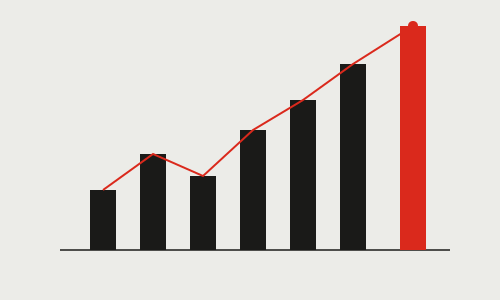
Swiss M&A activity in the SME segment recovered with notable vigour in 2025. According to Deloitte's 2026 Mid-Cap M&A Study, completed domestic and inbound SME sales reached 157 transactions, representing a 41% increase over 2024's figure of 179 — itself a year that had already contracted by 8.7% from the 196 deals recorded in 2023. The rebound reflects renewed buyer appetite, stabilising financing conditions, and a pipeline of succession-driven disposals that deferred activity from prior years is now releasing. At the same time, PwC Switzerland's M&A Trends Real Estate 2025 Outlook notes that real estate M&A faced a prolonged weak period in 2024 and was expected to recover only gradually as capital costs eased.
The gap between these two recovery curves is instructive. Operating businesses transacted at pace; real estate moved more slowly. The structural reason is not hard to identify: when real property sits inside an operating company, it does not simply transfer with the business. It must be addressed deliberately, early, and with qualified advice — or it will address itself, usually at the worst possible moment.
Swiss law is not indifferent to the problem. The Swiss Merger Act provides a corporate-law framework for separating assets through demerger, spin-off, or asset transfer procedures. In principle, these mechanisms allow a qualifying reorganisation to proceed on a tax-neutral basis at the federal level: tax values carry over, no gain is recognised at the moment of transfer, and the structure is preserved for the benefit of both the seller and the eventual acquirer of the operating business.
In practice, the qualification requirements demand careful attention. As RSM Switzerland's guidance on demerger tax implications makes clear, the transferred assets must constitute a qualifying "business" or "part of a business" for the tax-neutral treatment to apply under Swiss Federal Tax Administration rules. A portfolio of real estate assets held passively within an SME does not automatically meet this threshold. Where the real estate generates rental income and is managed with sufficient operational substance, the argument for business qualification is stronger. Where the property is simply the building in which the operating company works, the analysis is more nuanced and the outcome less certain without a prior ruling.
The procedural steps for a demerger or spin-off are substantive: board and shareholder resolutions, a demerger agreement that allocates assets and assigns liabilities with precision, and filing with the Commercial Register. Depending on the canton and the nature of the assets being transferred, notarisation may also be required. None of this is insuperable, but none of it is quick. A seller who begins this process after a letter of intent has been signed is, to state it plainly, already behind.
Federal tax neutrality, even when confirmed, does not extinguish cantonal real estate gains tax. This is a point that catches sellers with some regularity. The Swiss Federal Tax Administration's overview of the Swiss tax system confirms that every canton taxes real estate capital gains, though the mechanism differs: some cantons apply a dedicated real estate gains tax calculated on the appreciation in value; others integrate the gain into ordinary profit taxation for business assets. The result varies materially depending on the canton in which the property is located and how long it has been held.
More consequential for deal timing is the question of blocking periods. As Realtax AG's analysis of cantonal restructuring rules details, a tax-neutral separation does not necessarily clear the path for an immediate subsequent sale of the real estate. Cantonal rules impose blocking periods — typically ranging from two to five years — during which a disposal of the separated real estate may trigger retroactive taxation or forfeiture of the neutrality benefit. A seller who completes a carve-out in year one and sells the property in year two may find the tax neutrality unwound in part or in full.
The practical implication is straightforward: the carve-out timeline must be integrated into the overall transaction timeline, not appended to it. KPMG's M&A Market Trends analysis for 2025 and 2026 identifies portfolio reshaping and carve-outs as structural drivers of the next wave of Swiss M&A activity. That observation is accurate, but the execution risk embedded in real estate separation is precisely where value can erode if the sequencing is mismanaged.
The single procedural step with the highest return on time invested is the advance tax ruling, known in Swiss practice as a Steuerruling. Obtained from the competent cantonal tax authority before the reorganisation is executed, a ruling confirms whether the proposed structure qualifies for tax-neutral treatment, whether cantonal real estate gains tax will apply at the point of transfer, and what blocking period conditions — if any — will govern future disposals. PwC Switzerland's carve-out practice guidance and ESTV practice both reflect the same professional consensus: the ruling is not optional where material tax risk is present.
The value of the ruling extends beyond tax certainty. A buyer conducting due diligence on a cleanly separated operating business, supported by a confirmed ruling from the cantonal authority, can price the acquisition without embedding a real estate uncertainty discount. That discount, in the absence of clarity, is not theoretical. Sophisticated institutional buyers and family offices active in the Swiss market have seen enough post-closing property-related surprises to apply a meaningful haircut when the structure remains ambiguous at signing.
Once real estate has been successfully separated into a holding company or a distinct legal entity, the seller has access to structuring optionality that did not previously exist. The operating business can be sold via a share sale, which under Swiss law may allow the seller to benefit from the participation deduction — reducing or eliminating federal income tax on the gain — if the relevant conditions are met. The real estate, held separately, can be monetised on its own timeline, subject to the blocking period constraints described above.
This bifurcation is not merely a technical nicety. It allows the seller to optimise the tax treatment of each asset class independently, to present a clean operating business to operational buyers who have no interest in managing property, and to retain or separately sell the real estate to buyers for whom it represents a distinct investment. The ESTV's guidance on the participation deduction and capital gains treatment sets out the conditions; the analysis of whether those conditions are met in a given case belongs to a qualified Swiss tax advisor working from the specific facts.
The debate over property taxation is not confined to Switzerland. Observers in other jurisdictions have raised concerns about the cumulative burden of property-related taxes on owners and sellers. One perspective from the United States illustrates the broader political temperature around the issue:
I worry about taxpayers who local governments have overtaxed. Property tax revenue has nearly doubled for local governments this decade. The state has reduced its budget for 4 straight years — local governments can do the same. Floridians should not be taxed out of their homes!§ @RonDeSantis
And at the municipal level in the United States, budget pressures on property owners are equally visible:
The City of Austin is getting $82 million in property taxes more than last year for the 'proposed' budget. You wanna bet whether the final budget will be an even bigger property tax increase?§ @AleshireLaw
These observations from a different legal and political context are not directly applicable to Swiss cantonal tax structures, which operate under a separate constitutional framework. They do, however, reflect a shared underlying tension: property taxation tends to accumulate incrementally, and owners who have not actively planned for the tax event of a disposal often find the liability larger than anticipated. In Switzerland, where cantonal gain rates and holding-period adjustments vary significantly across 26 cantons, that observation carries particular weight.
The legal boundaries of property rights in transaction contexts also have a longer history worth noting. As summarised in one public thread:
The Kelo ruling permits eminent domain for economic development even when property transfers to private parties (not just government use), as long as there's a legitimate public purpose like jobs or tax revenue. The New London plan used a nonprofit corp as intermediary to developers, but the decisio[n]...§ @grok
The Kelo precedent is an American legal construct with no direct Swiss equivalent, but it serves as a reminder that the intersection of property rights and transaction structures is rarely simple in any jurisdiction. Swiss sellers need not fear eminent domain in this context, but they do need to respect the cantonal authority's capacity to impose and enforce tax obligations that follow the property regardless of corporate restructuring.
The 2025 recovery in Swiss SME M&A activity is a constructive backdrop for sellers considering a transaction. Buyer appetite is demonstrably present; deal financing has become more accessible; and succession-driven supply is translating into completed transactions at a rate not seen since before 2023. Against that backdrop, the temptation to move quickly is understandable.
The carve-out of real estate does not reward speed without preparation. The sequence that minimises risk is consistent across the professional guidance available from Swiss M&A and tax advisors: assess the real estate's position on the balance sheet and its tax cost basis early; determine whether the assets qualify as a business for the purposes of a tax-neutral reorganisation; obtain an advance ruling from the relevant cantonal authority; execute the separation with appropriate lead time before buyer engagement; and then bring a clean operating business to market with documented structural clarity.
That sequence takes time. In a market where deal momentum can shift, the seller who has completed these steps before the first indicative offer arrives is structurally better positioned than one who has not. The building may have appreciated for decades. Its treatment in a sale deserves proportionate attention.
This post reflects publicly available market observations and does not constitute legal, tax, or financial advice. Readers should consult qualified Swiss legal and tax counsel in connection with any specific transaction or reorganisation.