- · Swiss individual sellers strongly prefer share deals because capital gains on privately held shares are generally tax-free under federal law, an advantage rarely found elsewhere.
- · Buyers typically prefer asset deals because they can step up asset values, depreciate goodwill, and avoid inheriting the target's historical tax liabilities.
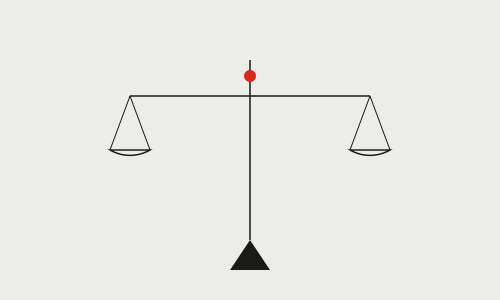
- · The structural misalignment between buyer and seller preferences is one of the most persistent negotiation flashpoints in Swiss mid-market M&A.
- · Compromise structures exist, but each carries its own tax and legal complexity that must be priced into the transaction architecture from the outset.
Few decisions in Swiss mid-market M&A carry as much financial consequence — and as little initial consensus — as the choice between a share deal and an asset deal. The moment a transaction moves from indicative offer to term sheet, buyer and seller typically find themselves gravitating toward opposite structures, each for reasons that are entirely rational from their own tax position. Understanding that divergence is not merely a technical exercise. For corporate advisors, M&A lawyers, and deal principals, it is the foundation upon which transaction pricing and deal architecture are built.
This post maps the competing tax interests of both sides, examines where the friction is sharpest, and surveys the compromise structures that practitioners in the Swiss market have developed to bridge the gap.
For a Swiss tax-resident individual selling a privately held company, the share deal is not simply convenient — it is, in most cases, transformative. Under Article 16 Paragraph 3 of the Federal Direct Tax Act (DBG), capital gains realized on the sale of privately held shares are exempt from federal income tax. This is a statutory privilege that the majority of comparable jurisdictions do not offer, and it means that a seller can transfer decades of accumulated enterprise value without triggering a federal income tax charge on the gain.
Corporate sellers operate under a parallel but distinct logic. Gains on shares held at a participation of 10 percent or more for at least one year qualify for the participation exemption at both the federal and cantonal level. The economic result is broadly similar: the gain is effectively sheltered from ordinary rates of corporate income tax.
Beyond the direct tax benefit, the share deal offers two further structural advantages that sellers value. First, the sale proceeds are paid directly to shareholders without the need for complex extraction mechanics through the target company. Second, the target itself experiences no tax event. Tax loss carry-forwards remain intact, and hidden reserves — the difference between book value and fair market value of the target's assets — are not crystallized by the transaction.
Taken together, these features make the share deal the dominant preference among Swiss SME owners approaching a sale. The tax logic is clean, the mechanics are relatively straightforward, and the economic upside of the capital gains exemption is, in most cases, too significant to trade away without substantial compensation.
A buyer's enthusiasm for a share deal is considerably more restrained, and for reasons that are equally grounded in tax economics. When a buyer acquires shares, it acquires them at cost. That cost cannot be depreciated unless the fair market value of the shares subsequently declines — an outcome no buyer enters a transaction expecting. Goodwill, which in many Swiss SME deals represents a material portion of the purchase price, cannot be separately capitalized on the acquiring entity's balance sheet and therefore generates no tax deductions against future earnings.
Beyond the depreciation problem, the share deal transfers the target's full tax history to the buyer. Deferred tax liabilities attached to hidden reserves, uncertain historical tax positions, and any legacy issues involving Swiss withholding tax on retained earnings all travel with the shares. Practitioners sometimes refer to the old reserves practice in this context: if the buyer later attempts to distribute retained earnings that carry a withholding tax taint from before the acquisition, Swiss tax authorities may subject those reserves to the higher pre-deal withholding rate, effectively preventing a future refund. It is a risk that does not always appear prominently in preliminary due diligence but that can surface with material cost several years after closing.
There is also the indirect partial liquidation rule to contend with. If, within five years following closing, the buyer distributes assets from the target that were non-operating or non-business assets at the time of the sale, the seller's originally tax-free capital gain can be retroactively requalified as a taxable dividend. In practice, this risk is typically addressed through a seller indemnity clause in the purchase agreement, but it represents an ongoing contingent liability that must be negotiated and priced.
The asset deal eliminates most of these concerns. The buyer allocates the purchase price across individual assets at fair market value, establishing a stepped-up tax basis that can be depreciated. Goodwill can be written down, often immediately, creating valuable deductions against future taxable income. Tax loss carry-forwards of the acquired entity can be captured and applied. Deferred tax liabilities are handled at the asset level rather than inherited wholesale at the corporate level.
If asset deals are so favorable for buyers, the natural question is why sellers do not simply accept them in exchange for a higher purchase price. The answer lies in the multiple layers of tax cost that an asset deal imposes on the selling side.
When individual assets are sold out of a corporate vehicle, the difference between the sale price and the book value of those assets is subject to corporate income tax. Depending on the canton of domicile, that rate ranges from approximately 12 to 21 percent. Real estate held by the target may additionally trigger real estate capital gains tax or property transfer tax, with rates and mechanics that vary significantly by canton.
The more structural problem is what happens to the proceeds. Following an asset sale, the cash consideration sits inside the target company. Distributing it to the individual shareholders requires a dividend, which carries Swiss federal withholding tax of 35 percent (recoverable for Swiss residents, but only through the refund procedure and after a waiting period). Other extraction mechanisms exist but each introduces further tax drag. The seller who agrees to an asset deal is therefore accepting a materially lower after-tax outcome than the seller who achieves a share deal at the same headline price — unless the buyer is prepared to gross up the purchase price to compensate, which most buyers are not.
VAT is a further consideration. Where both parties are Swiss VAT-registered, an asset transfer may in principle trigger VAT liability. The notification procedure offers partial mitigation by allowing the parties to defer reporting obligations rather than cash-settle the tax, but it requires careful structuring and advance coordination.
Given the opposing tax interests of buyer and seller, Swiss M&A practitioners have developed a range of compromise structures that attempt to distribute the structural burden more equitably. None of them eliminates the underlying tension; each represents a negotiated allocation of tax costs and risks.
The most common accommodation is the seller indemnity for indirect partial liquidation. The seller accepts the share deal structure but provides a contractual indemnity covering the buyer against any retroactive requalification of the capital gain during the five-year blocking period. This shifts the residual risk back to the seller while preserving the share deal's upfront tax efficiency.
Buyer-side tax ruling requests have become increasingly standard in transactions involving intended post-closing restructurings. By pre-clearing the planned steps with the relevant cantonal tax authority, the buyer gains certainty on the tax treatment of asset basis adjustments or intercompany reorganizations before committing capital.
Hybrid structures that pair a real estate asset sale with a share sale of the operating entity represent a more architecturally complex solution. Where the target holds significant real property alongside an active business, separating the two allows each component to be sold under the structure most favorable to that asset class. The operational logic of such arrangements can be intricate, but the tax savings available to both parties often justify the additional transactional overhead.
Earn-out provisions are another tool, though they require careful drafting. An earn-out that is economically tied to the seller's continued involvement risks being recharacterized as employment income by Swiss tax authorities, which would defeat the seller's capital gains planning entirely. Advisors structuring earn-outs must ensure that the contingent payment is genuinely linked to business performance rather than personal service.
Finally, staged closings with transitional service agreements can be used to defer the timing of asset basis step-ups, allowing buyer and seller to align on a transaction timeline that optimizes both sides' positions relative to their respective fiscal years.
One practical implication of all the above is that the choice of deal structure is not a downstream legal question to be resolved after commercial terms are agreed. It is a pricing variable. The after-tax proceeds available to the seller under a share deal at a given enterprise value are materially different from those available under an asset deal at the same headline figure. Any advisor who presents a purchase price without simultaneously modeling the structural assumptions is presenting an incomplete picture.
For buyers, the depreciation benefit of an asset deal has a net present value that can be calculated against the buyer's expected tax rate and holding period. Where that NPV is material — and in many Swiss SME transactions it is — it represents a genuine ceiling on how much price premium a buyer might rationally offer to induce a seller to accept an asset deal.
As noted in Walder Wyss's comparative analysis of acquisition structures in Switzerland, the tax treatment of each deal structure depends heavily on whether the seller is an individual or a corporate entity, and on the specific canton in which the target is domiciled — a reminder that Swiss M&A tax planning is never a purely federal exercise.
Bär & Karrer's 2025 review of Swiss M&A tax considerations similarly underscores that the participation exemption and the capital gains exemption for individuals are the two structural features that most consistently shape deal architecture in Swiss transactions, and that buyers and sellers who fail to model these early in the process routinely find themselves renegotiating terms at a late stage.
For SME owners approaching a first sale, the technical complexity of this area can feel remote from the practical reality of running a business toward an exit. The key takeaway is straightforward: the structure of your transaction will have a larger impact on your net proceeds than almost any other variable outside the headline price itself. Engaging tax counsel early — before indicative offers are submitted — is not a luxury. It is the minimum standard of preparation for a transaction of this significance.
For institutional buyers, family offices, and M&A advisors active in the Swiss mid-market, the structural misalignment documented here is a known feature of the landscape. Managing it effectively requires not only technical knowledge of Swiss tax law but also the judgment to identify, early in a process, which compromise structures are realistic given the specific facts of the target, the seller's profile, and the buyer's post-closing intentions.
The platforms and marketplaces where Swiss SME transactions originate serve as venues for that initial meeting of interests. The tax negotiation that follows is the work of the advisors on both sides of the table — and it is work that rewards preparation.
This post reflects publicly available market observations and does not constitute tax or legal advice. Parties to a transaction should engage qualified Swiss tax counsel to assess their specific circumstances.