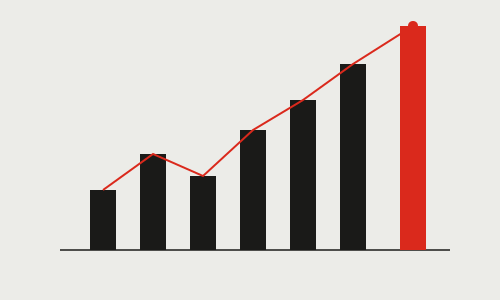
- · Inbound M&A transactions involving Swiss SMEs surged 65% in 2025, making foreign buyers the dominant price-setters in the market.
- · IT services and software now represent 28% of all deals (up from 14% in 2024), accounting for 90% of total deal volume growth.
- · Life sciences inbound deals rose 110% while domestic healthcare transactions fell 43%, reflecting a sharp geographic redistribution of capital.
- · Sector now determines valuation more than size: SaaS and life sciences businesses command EV/EBITDA multiples 2–3 times those of hospitality or general manufacturing.
The Swiss SME transaction market has long been characterised by measured domestic activity, family-to-family successions, and the occasional strategic acquisition by a larger regional industrial group. That picture has changed in a structurally significant way. According to Deloitte's 2026 review of Swiss SME M&A activity, total transactions grew 16% year-on-year in 2025, which is a respectable figure. What lies beneath it, however, tells a more consequential story.
Inbound transactions — those where the acquirer originates outside Switzerland — grew 65% over the same period. Domestic deals, by contrast, grew only 10%. Outbound Swiss acquisitions of foreign targets fell 25%. Taken together, these figures indicate that the structural centre of gravity in Swiss SME dealmaking has shifted away from domestic participants and toward foreign strategic and financial buyers.
For any owner evaluating a succession or sale in 2026, the practical implication is immediate: the relevant buyer pool has expanded considerably, but it has also become far more selective about what it wants to own.
Perhaps the most telling indicator of structural change is the behaviour of inbound private equity. Overall PE activity in the Swiss SME market rose 45% in 2025. Inbound PE bolt-on acquisitions — where an international sponsor adds a Swiss business to an existing platform — rose 156%. This is not incidental. Bolt-on acquisitions are precision instruments: sponsors pursue them when they have an existing thesis, a defined integration roadmap, and a clear view of value creation. A 156% increase suggests that international PE platforms have made Switzerland a deliberate target of their build-and-buy programmes, not merely an opportunistic consideration.
This has a direct bearing on valuation dynamics. When a strategic acquirer or consolidating PE platform competes for an asset, pricing is no longer anchored solely to local market conventions. It is anchored to what that asset contributes to an international portfolio — which, for the right business in the right sector, is a materially higher number.
The 2025 data from Deloitte reveals a sectoral divergence so pronounced that it effectively describes two separate markets operating under the same national flag.
IT services and software represented 14% of all domestic and inbound deal activity in 2024. In 2025, that figure reached 28%, and the sector was responsible for approximately 90% of the entire year's deal volume growth. Life sciences and healthcare inbound transactions grew 110% year-on-year. Simultaneously, domestic healthcare deals fell 43% — a pattern that strongly suggests foreign consolidators are out-competing Swiss domestic buyers for the same assets.
Industrials and consumer services, meanwhile, each declined roughly 4% in deal count. Hospitality has not meaningfully benefited from any wave of foreign buyer enthusiasm.
The Val Index Swiss SME EBITDA Valuation Multiples database, which tracks 132 industries, provides a useful framework for understanding what this sectoral bifurcation means in practice. SaaS and B2B software businesses currently trade in a range of 7.0–12.5× EBITDA, with demand characterised as high and the trend direction rising. Life sciences and pharma businesses trade at 7.0–14.0× EBITDA under similar conditions. Healthcare clinic groups — the consolidation play that dental and specialist clinic operators know well — command 6.0–11.5× EBITDA with stable demand and elevated acquisition appetite.
At the other end of the spectrum, general machining and manufacturing businesses are transacting at 3.0–6.0× EBITDA, and hospitality assets at 3.0–7.0× EBITDA.
The spread between a well-positioned SaaS company and a hospitality business is not marginal. It is, at the upper bounds, a difference of nearly 2× in the multiple applied to the same unit of earnings. For an owner deciding whether 2026 is the right year to transact, sector positioning is no longer context — it is the headline.
Regional concentration in Switzerland's M&A market is equally pronounced. Zurich canton alone accounted for 32% of all domestic and inbound transactions in 2025. This reflects the obvious logic of economic geography — Zurich hosts the greatest concentration of scalable technology businesses, financial services, and life sciences infrastructure. But it also means that owners of comparable businesses in other cantons may face a thinner buyer market, at least in terms of locally-anchored activity. International buyers, by definition, are less constrained by regional considerations; they are acquiring capability, not proximity.
It would be incomplete to examine Swiss SME M&A without acknowledging the broader environment in which it sits. Global M&A data for the first half of 2026, as reported by Mondaq and supported by EY's financial sector analysis, describes what analysts have taken to calling a K-shaped market: deal values are robust — global M&A reached USD 2.8 trillion in value in H1 2026, the highest half-year total since 2021 — but deal volumes have fallen 14% compared to the first half of 2025.
In Europe specifically, private equity investment committees have become more cautious on new platform investments. Sticky interest rates, geopolitical uncertainty, and persistent pricing gaps between buyers and sellers have lengthened timelines and increased selectivity. Sponsors are leaning into continuation vehicles and secondary buyouts rather than fresh commitments to unproven assets.
Switzerland, somewhat unusually, has insulated itself from the worst of these pressures. The Swiss National Bank has maintained financing conditions supportive of deal activity, GDP growth is forecast at 1.1% for 2026, and inflation sits near 0.2%. The supply side of the market is well-stocked, driven by pent-up succession cases, corporate portfolio rationalisation, and PE divestments returning capital to investors. Switzerland, in other words, is offering buyers a relatively stable macroeconomic harbour at a moment when that attribute commands a premium.
The dental sector provides a useful case study in how consolidation dynamics work in practice. Val Index data characterises Swiss dental practices as a sector worth approximately CHF 5.2 billion, comprising around 4,800 companies and 28,000 employees, growing at roughly 3.5% annually. Acquisition appetite from consolidators remains elevated. This is precisely the profile that draws international PE platforms: fragmented, recurring-revenue businesses in a regulated sector with predictable demand and identifiable operating efficiencies to unlock through consolidation.
The 110% surge in life sciences and healthcare inbound transactions reflects the same logic operating at scale. International platforms have identified Swiss healthcare as a fragmented, high-quality target landscape. Domestic buyers, operating under tighter capital constraints and more conservative investment mandates, have been outbid or outpaced.
This post does not offer advice, and the market observations above should not be read as guidance on whether or when to sell. What the data does suggest, as a matter of market observation, is that the conditions in 2026 are sector-specific in a way that 2022 or 2023 were not. The premium for operating in IT services, software, or healthcare is measurable, documented, and driven by a buyer cohort — international strategics and PE platforms — that was far less active in previous years.
Owners of businesses in structurally depressed sectors face a different calculus. Hospitality and traditional manufacturing are not in crisis, but they are not benefiting from the wave of inbound capital that is revaluing technology and healthcare assets. Patience, operational improvement, and careful positioning remain the available levers.
For those in the sectors where inbound demand is acute, the market is offering multiples that, a decade ago, would have been considered aggressive for private Swiss SMEs. Whether those conditions persist into 2027 is not something any analysis can predict with confidence. What is observable is that 2025 marked a decisive inflection point — and 2026 appears to be extending it.
Sources: Deloitte M&A Activity of Swiss SMEs 2026 (deloitte.com); Val Index Swiss SME EBITDA Valuation Multiples (valindex.ch); Mondaq M&A Insights 2026; EY / Funds Society Global M&A H1 2026.